Small Island Nations Confront a Funding Vacuum in Race to Protect Biodiversity
Small island nations are struggling with chronic funding shortages that threaten their ability to protect biodiversity and meet the global 30x30 target.

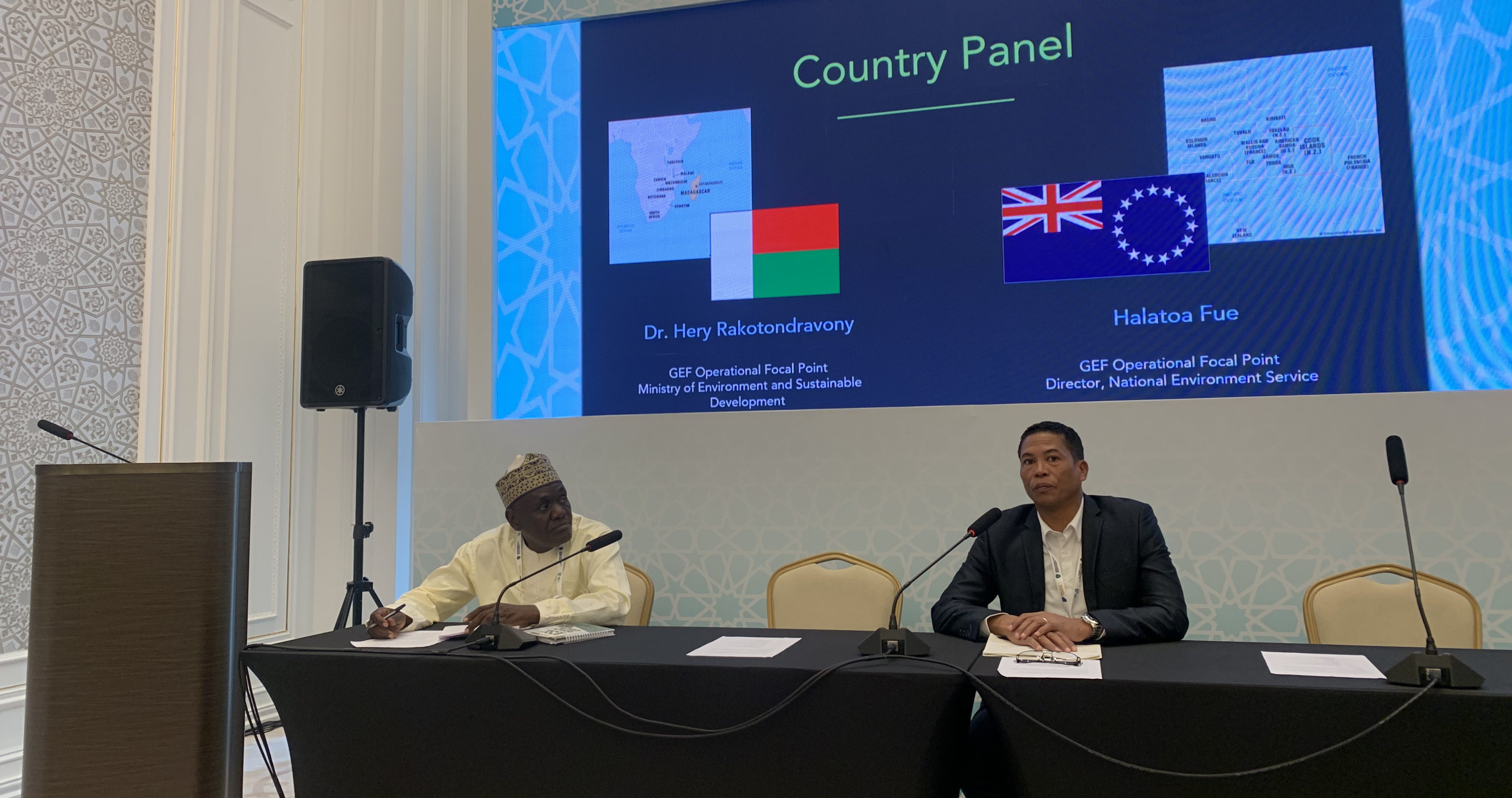
As the world edges toward the 2030 deadline for the Global Biodiversity Framework’s “30x30” target, representatives of vulnerable island states are delivering a consistent and sobering message, which is that ambition is not the problem, resources are. In recent presentations at the side events of the Eighth Global Environmental Facility (GEF) Assembly in Samarkand, Uzbekistan, senior environment officials from the Maldives, Madagascar, and the Cook Islands laid bare the gap between policy progress and the financial firepower needed to confront rapid environmental degradation, coastal threats, and biodiversity loss.
Their accounts revealed sophisticated legal and planning frameworks colliding with underfunding, capacity constraints, and the overwhelming pressure of local realities as a pattern familiar across Small Island Developing States (SIDS) and islands part of Least Developed Countries (LDCs).
Madagascar’s GEF Operational Focal Point, Hery Rakotondravony, spoke candidly about the domestic headwinds. With population growth nearing 3% annually and the national population swelling from roughly 22.5 million to 30 million in a decade, demand for agricultural land has driven “very huge” deforestation and conversion of primary ecosystems. “Every scale per liter of primary habitats in Madagascar has a huge value in terms of biodiversity conservation,” Rakotondravony noted, “but the challenge is that there is the population growth, there’s high demands on lands, mining, fisheries, and agriculture.”
Legal tools to protect the environment are advancing in the African island nation. An updated protected areas code is overdue, a new integrated coastal zone management framework is under review, and a Blue Economy Trust Fund has been created. Yet the Focal Point, who is also the technical collaborator of climate change at the Ministry of Environment in Madagascar, repeatedly circled back to the same constraint, that “one of the last and the biggest challenges is resource availability.” International mechanisms exist on paper, but operationalizing them through funding remains elusive.
The Maldives, a nation of low-lying atolls exposed to sea-level rise, has made measurable progress. It maintains 93 protected areas, including three biosphere reserves, and aims to double the latter while establishing nature parks by 2028, according to the Minister of Climate Change, Environment and Energy of the Republic of Maldives, Ali Shareef. The country submitted protected area management effectiveness data to global databases, one of the first to do so, and is advancing a national 30x30 roadmap. Shareef, however, highlighted the same structural barrier. “The main hurdle... is unavailability of the funds, and conservation is an area where leverage in private sector financing is challenging,” he said.
Even in a tourism-dependent economy, attracting sustained private capital requires visible government commitment and “grant-based financing” as seed money. Without reliable international support, protection will remain patchy and management effectiveness will always lag. The minister stressed that financing must become “largely grant-based, accessible, and sustainable” if private sector engagement is to scale.
Half an ocean away, the Cook Islands, via their Director of National Environment Service, Halatoa Fue, described an integrated marine spatial planning (MSP) process underway to reach the remaining share of the 30x30 target. Their approach incorporates traditional knowledge, biodiversity hotspots, fisheries, and climate resilience. The Cook Islands has a minuscule land mass but a vast Exclusive Economic Zone of about two million square kilometres, according to Fue, and the country has used its 2017 Marae Moana Act to legally protect 14.8% of its waters through 50-nautical-mile no-take zones around each island. In his speech, the director also spoke frankly about their capacity needs, including technical assistance for GIS, spatial analysis, monitoring, surveillance, and satellite tools.

Finance looms large, so the Cook Islands are developing an ocean finance framework and eyeing the Bezos Earth Fund and other sources to establish sustainable financing mechanisms for the additional marine protected areas required. “In small islands, we have capacity and technical assistance gaps,” Fue noted, underscoring that legal architecture alone cannot deliver results without money and expertise.
All these testimonies illuminate the structural challenges facing SIDS and island LDCs. Many possess enormous marine territories relative to land, making their ocean governance central to 30x30 ambitions. They face disproportionate climate impacts, including coral bleaching, coastal erosion, and salinization that accelerate biodiversity loss while their economies remain narrow and debt-vulnerable. In places like Madagascar, demographic pressures additionally compound habitat conversion, and their geographic isolation raises the cost of technology transfer and data management.
International funding streams, including the Global Environment Facility, Green Climate Fund, and various biodiversity funds, have grown, yet access by small bureaucracies can sometimes remain cumbersome. They struggle with the complex application processes, co-financing requirements, and short project cycles that fail to match the long-term nature of conservation. Private finance is also often reluctant to enter high-risk and low-volume island contexts without de-risking instruments, so the result is always often an implementation gap.
The High Ambition Coalition for Nature and People and similar initiatives can play a catalytic role in accessing the funds, and the Maldives minister suggested that in his speech. He noted that this can be done by helping translate grant seed capital into blended finance vehicles that unlock private resources. Without simpler access to funds for SIDS and other island LDCs, and greater flexibility in how they can be used, the risk is that 2030 targets become aspirational rather than realizing the goals of protected landscapes and seascapes.

