How the Nigerian Conservation Foundation Is Supporting Nigeria’s Sustainability Ambitions in the Ninth GEF Funding Cycle

The Nigerian Conservation Foundation (NCF) is implementing several GEF-funded projects in Nigeria, including the restoration of Omo Forest in Ogun State and, in partnership with the UNDP, landscape restoration in the Hadejia-Nguru Wetlands in Yobe State, where it also provides early warning signals to farmers to mitigate desert encroachment impacts in the Majakura community.
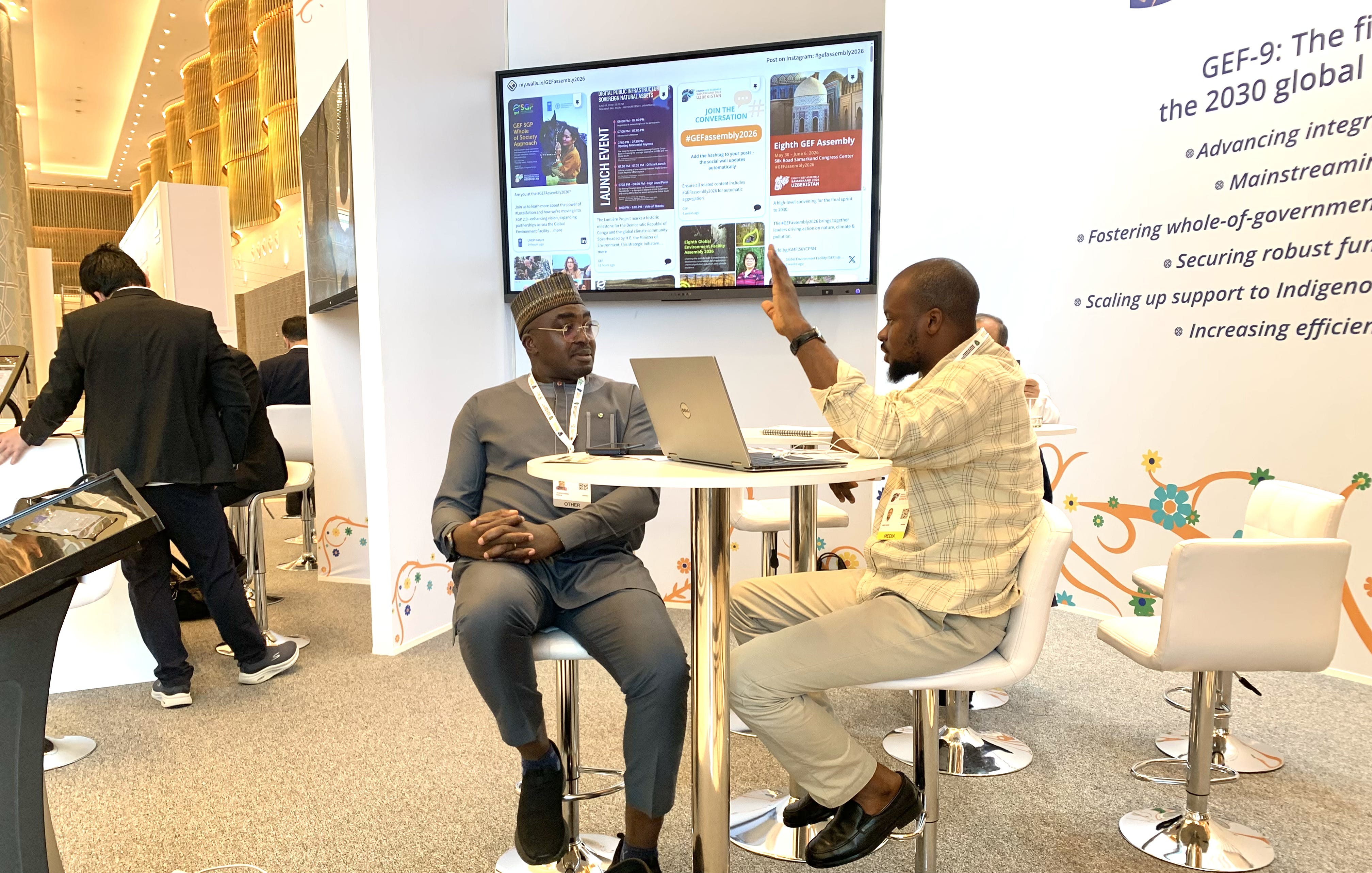
At the sidelines of the Eighth GEF Assembly in Samarkand, Dr. Joseph Onoja, Director-General of the Nigerian Conservation Foundation and Global Biodiversity Framework Fund (GBFF) Council member, spoke to The Habibat Project about the organization’s expectations ahead of the ninth GEF funding cycle (GEF-9), which begins in July. He also provided details on ongoing environmental projects as well as future initiatives he hopes will receive priority under GEF-9, such as developing the Nigerian segment of the East Atlantic Flyway for migratory birds and expanding it to cover other species while creating sustainable livelihoods for local communities and still fulfilling the core objective of protecting the birds.
The projects he spoke about address many aspects of the biodiversity conservation and land restoration work that is urgently needed in Nigeria. However, for many of them, seamless knowledge management and transfer, inter-organizational coordination, and even hope are needed to overcome the challenges of implementation they face.
(This interview has been edited for length and clarity)
You’ve been at the Eighth Assembly and have attended key council meetings. In what capacity are you doing so?
I’m here specifically for the GBFF Council meeting, because I occupy an observer position from the philanthropy and private sector, representing the Nature Positive Initiative, which BirdLife International is a member of. The Nigerian Conservation Foundation is a BirdLife International partner. I am representing BirdLife on the NPI Coalition of the GBFF Council.
What projects might the Nigerian Conservation Foundation be implementing or supporting with GEF Implementing Agencies in Nigeria?
NCF is partnering with FAO on two projects. One is on restoring the forest landscape in Ogun State. It’s a lowland forest landscape across Ogun, Ondo, and Edo States, but NCF is focused on the Ogun component, which is the Omo Forest Reserve. The second is the Capacity Building Initiative for Transparency of the Paris Agreement (CBIT), which involves building the capacity for the five emitting sectors of transport, industrial processing and product use, called IPPU, energy, agriculture, and AFOLU, which is Agriculture, Forestry, and Other Land Uses, to be able to transparently report their emissions in Nigeria. We work very closely with the Federal Ministry of Environment, Federal Department of Forestry, the National Council on Climate Change, other MDAs that oversee all those areas, the focal points, and sub-nationals to be able to report that. We are also working with the UNDP Small Grants Programme, which is also a GEF-funded program looking at the landscape in the Hadejia-Nguru Wetlands in Yobe state, where we are working specifically in a community called Majakura to build early warning signals for the local communities and the farmers to fight desert encroachment.
What are some of the key challenges facing these projects that you hope can be resolved in the next GEF cycle?
The initial setup is usually very tough for projects. It involves bringing in partners, selecting who is going to be involved and what expertise they’ll be bringing on board, documentation, and clearly defining the project direction. All the processes have their own bottlenecks and long stages.
Is the government largely responsible for these bottlenecks?
No, I think it’s both ways. It is what we call a necessary evil; it is the normal bureaucracy that has to take place. The MDAs have to commit, and then we need to have an understanding that even if they are going to replace someone (because in the civil service, you don’t see one person continuously), that person has to pass down the knowledge. It shouldn’t be a new person coming in who doesn’t even know what is happening. There should be that institutional knowledge. But sometimes there can be that break, and then you start all over again. That’s why we need commitment from the various MDAs to ensure that even if a new person comes in, that person will have the knowledge to be able to continue from where the old person stopped.
Did you experience this knowledge management problem with any project specifically?
It’s a normal experience. That’s why we are emphasizing it now, so that it doesn’t occur again. Because you don’t want a situation where you’ve trained people for Phase 1, Phase 2, and by the third phase, the person coming in doesn’t even know what happened in Phases 1 and 2. That means you have to start all over again. This happens over time, because ministries are dynamic, the MDAs are dynamic—it’s not only one person, and some people can be moved around. We just want to emphasize that when people are moved around, they should at least pass on that knowledge, that institutional memory, so whoever is coming will not face that kind of issue. Another challenge, which innovatively one can overcome, is the issue of the funding that goes to the TSA (Treasury Single Account). Sometimes, when projects don’t have a dedicated account, it becomes a bit cumbersome to manage the funds. Once money is pumped into the TSA, you require approval of funds from the highest level, probably at the director level, for projects to kick off. If you have to go through that bureaucracy and the TSA for approval, that’s a bottleneck. I will allow the government to talk about it, but that’s something from the outside that we are seeing as a challenge.
As a GBFF council member, what were some biodiversity projects that Nigeria proposed to the Council that got approved or rejected?
We didn’t see any project from Nigeria that got to the stage of the council for them to approve or reject. It’s not that they rejected them. I think Nigeria’s project — because I’m also in touch with the Operational Focal Point (OFP) of the CBD (Convention on Biological Diversity) — is still being developed. It has not gotten to the council yet. It is a phased process, where criteria must be met for approval. GEF-9 is just starting in July. I think they’re going to approve submitted Nigerian projects at the next GBFF council meeting in December.
What are some projects that the NCF will be initiating to receive GEF-9 funding?
We’ve been having discussions. I’m sure the Ministry of Environment and the new GEF Focal Point have also discussed this with other entities as well. For us at NCF, one of our interests is the flyways. We are looking at landscapes too.
What are flyways?
Flyways are for migratory birds. There are eight flyways.
Are they migration routes?
Yes. Birds migrate from the North Arctic all the way to South Africa. Some migrate from the Arctic through Europe. They migrate from the Mediterranean, then through the Sahara Desert, through Sub-Saharan Africa, all the way to South Africa. We want to ensure that the flyways are well protected right along these paths. We want to ensure that we have these flyways as part of the cycle in the GEF-9 granting, because when you protect flyways, you are not only protecting them for birds, you are protecting them for every other biodiversity that happens to be on that flyway. We are looking at Key Biodiversity Areas (KBAs) as well which form part of Target 3 of the KMGBF (Kunming-Montreal Global Biodiversity Framework), which aims to protect 30 by 30 (30% of the landscape of every country by 2030). Nigeria now has to rank all of these priorities and follow up. I’m yet to discuss with the OFP to know what the priorities are this time.
For those flyways, what funding mechanisms are you targeting? Is it the small grants programme or the actual main financing?
The main financing will be better. Because when you talk about flyways, you’re talking about different components, including livelihoods, habitat restoration, species conservation, and even marine conservation. Flyways encompass a lot of things. For instance, the Hadejia-Nguru Wetlands is a major bird stopover site, as we’ve been monitoring the bird population in that landscape for over 20 years. We do that every year. It’s a major stopover for them. Also, we have the East Atlantic Flyway, and all of Nigeria is in that flyway, but we’re also looking at the marine component of it as well. If you talk about marine protected areas, you talk about mangrove conservation, you talk about livelihood improvement — all of these things are part of what will come as different projects, bankable projects under the flyway programme. That’s why we are open as NCF to work closely with the government to prioritize this project.
Has any progress been made so far on this flyway project or are you waiting for financing?
As I said, we have been working with the communities in the Hadejia-Nguru Wetlands. We received a GEF small grant of $50,000, which is what we are implementing with the communities in Majakura for this project. It is part of our flyway. In this northern part of the country, you can develop what we call the shea butter range, where you empower local communities, especially women, to be able to grow shea butter. There, these migratory birds will feed on the insects that lay their moths or their caterpillars on this shea butter. Meanwhile, the shea butter is producing economic value for the women, and then it’s restoring the landscape because it’s fighting the desert encroachment, and also the birds are benefiting from it. You can term it Birds, Bees, Biodiversity, and Business (BBBB) all put together, and local communities are at the heart of such implementation.
What’s your take on Nigeria defaulting on its pledges to the GEF?
In terms of dues, we are owing almost every convention that Nigeria has signed on to. We are owing not just one year, but multiple years, which is sometimes an embarrassment when we come out to participate. Sometimes, for a country to be able to speak at conventions, they don’t even allow you to speak. When you are not at the table, you become the menu. When things are being discussed, and Nigeria is not there to provide that leadership, then you cede your right to other smaller countries, which is not good for Nigeria. There are many advantages that come with occupying such leadership positions.
This story was produced as part of a reporting fellowship to the Eighth GEF Assembly supported by Internews’ Earth Journalism Network.

